Thinking in First Principles
The Subtle Art of Independent Thinking

1. The Foundations
Most of the world runs on borrowed thinking. We copy what worked before. We follow playbooks written by someone else. We assume the crowd must know something we don’t. It’s efficient, it’s safe, and—most of the time—it gets us by.
But safe thinking rarely produces breakthroughs.
Every major leap in business, science, or even personal growth has come from people who refused to accept inherited assumptions. Instead, they asked a different question: what are the fundamentals here? What’s true at the most basic level, no matter what others believe?
That is first-principles thinking.
The concept dates back to Aristotle, who described first principles as the foundation of knowledge—the things that cannot be reduced any further. Centuries later, the scientific revolution used the same approach to overturn centuries of dogma. More recently, Elon Musk revived the language of first principles to explain how he approached batteries and rockets: not as “what others say is possible,” but as raw physics and costs.
In a world drowning in noise, where narratives shift daily and everyone is working off second-hand beliefs, the rarest skill isn’t more information—it’s clarity. And clarity comes from thinking in first principles.
2. The Roots of First Principles
The idea of first principles isn’t new. It’s as old as philosophy itself.
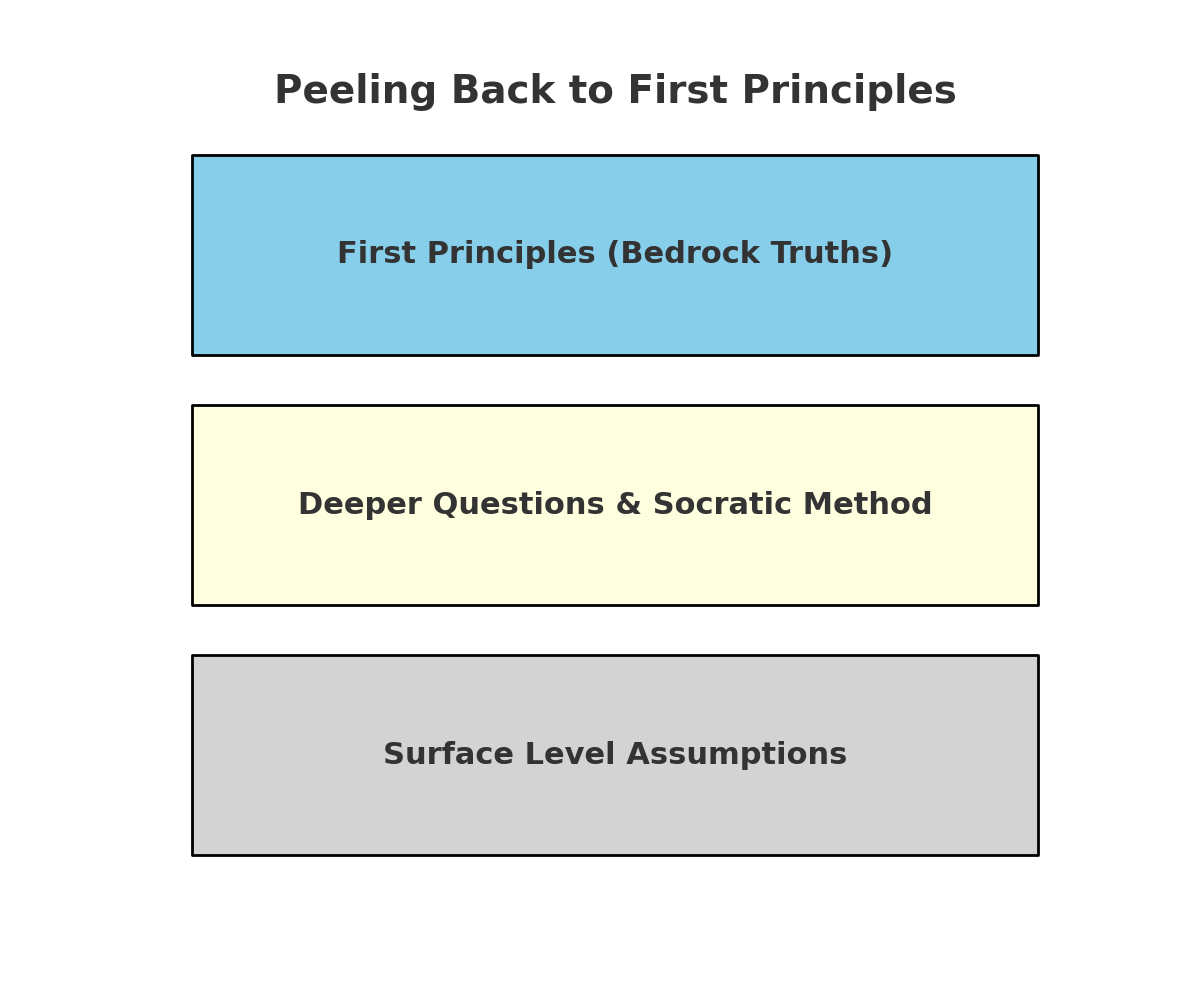
Aristotle argued that real understanding comes from tracing things back to their fundamental truths—the pieces that can’t be broken down any further. Think of them as the bedrock beneath the sand. If you build on the sand (tradition, opinion, analogy), it shifts with the tide. If you build on the rock (first principles), it endures.
History’s great inflection points almost always came from someone going back to that bedrock. Galileo didn’t accept that heavier objects fall faster just because Aristotle had once said so. He tested it. Two spheres dropped from the Leaning Tower of Pisa—same time, same landing. Centuries of “settled wisdom” undone in a single experiment.
Newton did the same with motion, reducing the chaos of the natural world to universal laws. The scientific method itself is nothing more than a structured way of returning to first principles: observe reality directly, test it, refine it.
In engineering, this mindset became the difference between incremental progress and moonshots. The Apollo engineers didn’t just copy the Soviet rocket program—they reduced the problem to thrust, weight, trajectory, and built from there. Musk did the same when he questioned why rockets had to cost hundreds of millions. The raw materials were cheap; the convention was expensive.
Every time humanity has broken through a ceiling, it happened because someone stopped asking, “What have others done?” and started asking, “What is true?”
3. Why Humans Default to Analogy
If first principles are so powerful, why don’t we use them more often? The short answer: energy.
The human brain is wired for shortcuts. It evolved to save time and effort, to use heuristics and copy the crowd. Social proof is efficient. Authority bias is comforting. It’s easier to assume the existing path is right than to wrestle with uncertainty.
That’s why so much of the world runs on analogy.
A founder says, “This is the Uber for X.”
An investor says, “This reminds me of the last cycle.”
A manager says, “This is how we’ve always done it.”
Analogy reduces cognitive load, but it also narrows imagination. It prevents us from seeing possibilities that don’t fit the mould.
The danger is that analogy-based thinking is seductive because it works often enough to be convincing. You can build a decent business by copying playbooks. You can survive by doing what’s always been done. But you’ll rarely create something transformative.
In venture, I see this constantly. Startups pitch themselves as a variation of something that worked elsewhere, assuming the analogy is enough to prove viability. Yet when you strip down the market, the physics don’t hold—customer behaviour is different, unit economics don’t scale, regulation kills the model. The analogy hides the flaw.
First-principles thinking is uncomfortable because it forces you to stand alone. It requires you to ask questions others avoid, and to accept that the crowd may be wrong. But that’s also why it produces the rarest edge. The recent post I did on Howard Marks’ memos demonstrates a perfect example of someone who lives by ‘thinking in first principles’ - never taking the conformist view.
4. First Principles in Business & Venture
Business is where the distinction between analogy and first principles becomes most visible.
Take Tesla. In the early 2000s, conventional wisdom said electric cars were a non-starter. Battery packs cost over $600 per kilowatt-hour, making them commercially unviable. Automakers shrugged and moved on. Musk asked a different question: what are the raw inputs of a lithium-ion battery—cobalt, nickel, aluminum, graphite—and what do they actually cost on the open market? When you added it up, the theoretical cost was closer to $80 per kilowatt-hour. The problem wasn’t physics; it was convention. Tesla built around that truth, and the industry was forced to follow.
The same dynamic plays out in venture capital. Most investors lean on patterns: what’s hot, what’s been funded before, what TAM slide looks biggest. They borrow conviction from precedent. But precedent can be misleading.
A first-principles investor strips back the noise:
What is the customer’s real, unsolved problem?
What are the non-negotiable economics of solving it?
Which moats—distribution, data, switching costs—are durable, and which are illusions?
This lens matters more than ever in AI. The analogy-driven view says the hyper-scalers will inevitably win because they have more compute and data. But strip it back: what does the end user care about? A hospital doesn’t need the biggest model; it needs reliability, compliance, and integration into workflows. A law firm doesn’t care about trillion-parameter benchmarks; it cares about whether the AI drafts contracts that stand up in court. By first principles, the edge often lies with vertical AI players who build for precision and context, not scale alone.
In venture, the biggest outcomes often come from those willing to ignore the analogies of the last cycle. Every bubble has been built on borrowed reasoning. Every great fund return has come from a team that stripped it down and rebuilt the thesis from fundamentals. Generational founders are masters at thinking in first principles.
5. First Principles in Personal Performance
This isn’t just a business tool. First-principles thinking applies just as powerfully to life. Wellness culture is full of noise: supplements, gadgets, protocols, bio-hacks. Most of it is analogy thinking—copying what seems to work for others, hoping it transfers. Few ask the harder question: what drives human physiology at the most fundamental level?
When I look at my own recovery metrics—HRV, resting heart rate, sleep—I notice the pattern. My best performance days aren’t after a new supplement or gadget. They’re after high-quality sleep, solid nutrition, and managed stress. Those are the fundamentals.
Sleep regulates hormones, which drive energy and cognition. Recovery governs resilience. Nutrition underpins cellular function. These are first principles. Everything else—cold plunges, infrared light, exotic supplements—are optimisations layered on top.
The parallel to business is obvious. Without product-market fit, a startup can’t be saved by clever marketing hacks. Without the fundamentals of physiology, performance won’t be saved by the latest trend. The edge comes from stripping away noise, focusing on the drivers that really move the needle, and building habits around them.
6. Practicing First Principles Daily
So how do you actually do this?
It starts with spotting assumptions. Whenever you find yourself saying, “that’s just how it works,” pause. That’s a sign you’ve hit an inherited belief.
Then break the problem into fundamentals. In business, that might mean customer needs, cost of goods, and distribution physics. In performance, it might mean energy balance, sleep, and stress.
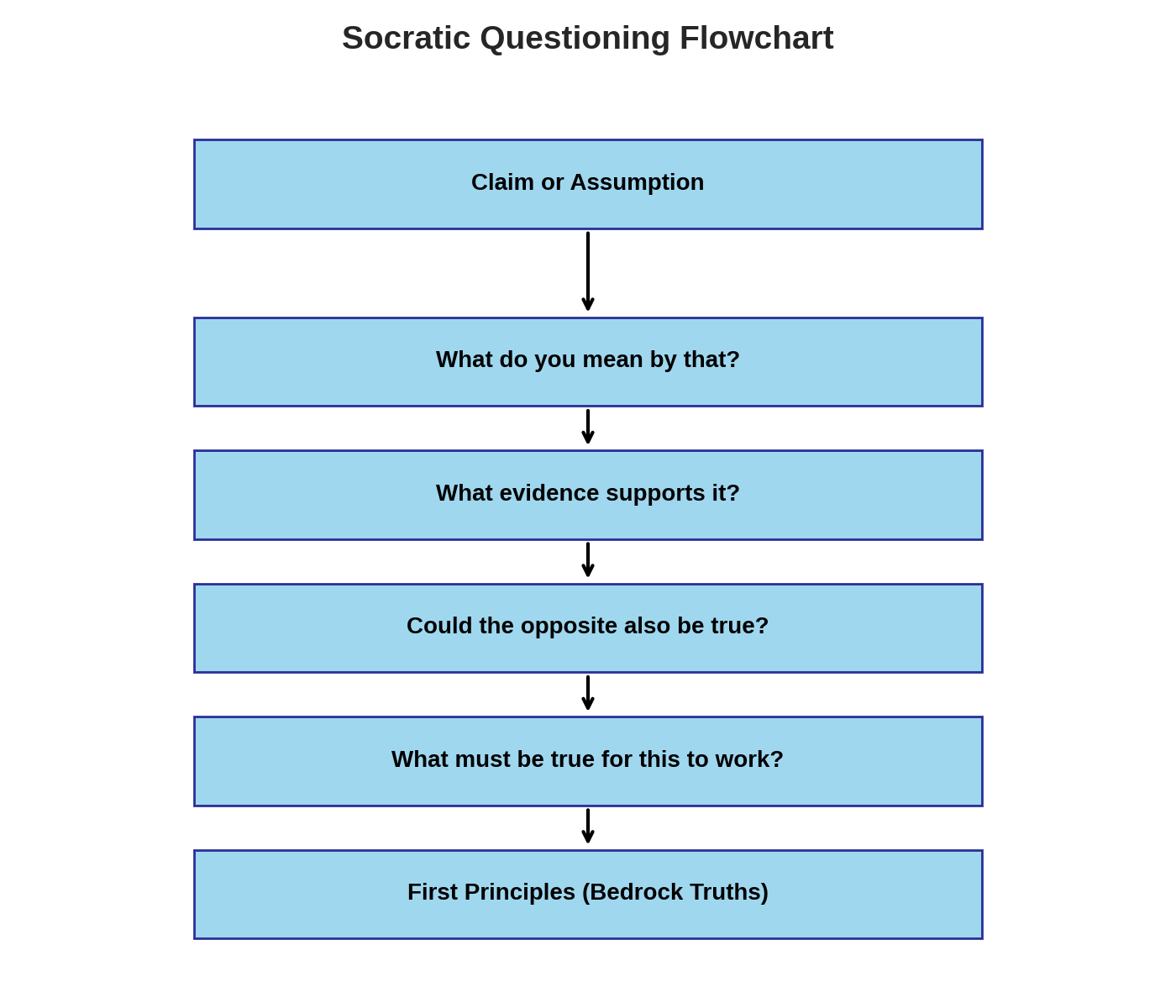
One powerful tool here is Socratic questioning—a discipline as old as philosophy itself. Socrates never told his students the “answer.” Instead, he kept asking questions until their assumptions collapsed under their own weight: What do you mean by that? What evidence supports it? Could the opposite also be true? By peeling away layers of assumption, you eventually land on the things that cannot be reduced further—the first principles.
In practice, you can use this same method on yourself or with your team. Whenever a decision feels obvious, interrogate it:
Why do we believe this is true?
What if the opposite were true?
What must be true for this plan to work?
What would break if one of our assumptions failed?
Rebuild from there. What solution emerges if you start fresh from those truths, ignoring convention?
Finally, test and refine. First-principles thinking isn’t stubborn dogma; it’s disciplined clarity. It forces you to separate what must be true from what’s simply been assumed.
One warning: don’t reject analogy altogether. Sometimes copying is efficient. You don’t need to reinvent how to run payroll or design a chair. The art is knowing when to use analogy and when to fight through to first principles. Think of it as a barbell strategy: default to analogy where the stakes are low, fight for fundamentals where they matter most.
In a world where most people chase patterns, precedent, and playbooks, the edge lies in clarity. Clarity that comes only from stripping back the noise, finding the bedrock truths, and rebuilding from there.
As an investor, I actively look for the rare founders who think this way—people who don’t just copy what worked last time, but who can strip their market down to raw fundamentals and rebuild something new. And I try to hold myself to the same standard. Like anything, the more you practice it, the more you rewire your brain to default to that mode of thinking. It becomes less about trying to think differently, and more about simply seeing the world as it really is.
That’s what it means to think in first principles. Not a philosophy lecture, but a practical discipline—the more you read, learn and take an interest in the world the more effective you become. Neuroplasticity means the brain adapts to the patterns we repeat. The more you question assumptions, read widely, and push yourself to break ideas down, the more natural it becomes. What feels forced at first gradually becomes instinct. Thinking from first principles shifts from being a tool you consciously deploy to a lens you automatically see the world through.