The AI Enablement Playbook
Inside the AI transformations of Intercom, Moderna, JPMorgan and Palo Alto Networks

Ask most people about AI today and the conversation goes to models or agents. The question I find more useful is a simpler one: who is actually using this well? Plenty of companies talk about AI. Very few can show you where it has genuinely changed how they operate.
Last year I wrote a piece called AI Enablement: What It Really Means (link below) - the difference between bolting AI onto the edges of a company and redesigning the system underneath it. This piece is the follow-up, and the format is simple: four companies I've followed closely, across four different industries, each running a distinct playbook and each documented in filings, published metrics and their own disclosures rather than press releases. What they did, what actually changed beneath the tools, and key learnings. Think of it as the article I'd send any operator who asks me where to start.

1. The Question I Keep Getting Asked
My earlier piece argued that most of what passes for AI adoption is activity at the interface layer - a chatbot, a copilot, pilots that demo well and change nothing. It creates the feeling of progress without compounding into anything structural. Real AI enablement is different in kind: it means redesigning the system that produces output - the workflows, the data layer, the org structure, the decision rights - so that AI generates a substantial share of output by default and humans move to judgment and exceptions. The gap between companies that understand this and companies that don’t, I argued, would become the defining competitive divide of the decade.
And the question is getting easier to answer, because the evidence has become more widely adopted across companies and into the P&L. Revenue per employee is diverging. Headcount curves are flattening against growing revenue lines. CEOs are being asked about AI on earnings calls and, for the first time, answering with numbers.
So this piece looks at four companies I’ve followed closely that have done this genuinely well. Not a definitive ranking - a growing number of companies are executing seriously now, from Shopify making reflexive AI use a baseline expectation in performance reviews, to Goldman Sachs rolling its assistant across the firm, to Walmart embedding AI through its supply chain. But these four stand out because each represents a distinct playbook, each is documented in primary sources rather than press releases, and together they span four very different industries - which is what makes the pattern worth studying. The criteria I applied: results you can verify, system-level change rather than tool adoption, and enough variety to show the playbook generalises beyond tech.
One exclusion worth naming, and one distinction. AI-natives don’t count here - a company born with AI at the centre never had to do the hard part, which is transforming a production function that already exists. Enablement is a story about incumbents changing. The distinction is more nuanced: selling AI is not the same as being transformed by it, and plenty of “AI winners” lists conflate the two. A company that ships AI features while running its own operations exactly as before doesn’t qualify. But a company that rebuilt itself first and then turned that rebuild into a product is the strongest version of what this article is about - two of the four below did precisely that.
This also isn’t the first time I’ve done this exercise. Regular readers will remember my piece unpacking Ramp - the clearest and earliest example I’d seen of AI enablement done properly, with Glass, the Dojo skill marketplace and the L0-L3 maturity framework. That article is the companion to this one, with each individual company offering important, unique takeaways for AI enablement. Link to my previous Ramp article below:

This article covers the four companies below and the AI enablement playbook each represents:
Intercom - the customer service software company that killed $60 million of revenue to fund an all-in AI bet, then rebuilt its product, its org chart and its pricing model around the result.
Moderna - the biotech behind the mRNA Covid vaccine, which ran one of the deepest enterprise AI deployments anywhere and redrew its executive structure to make it work.
JPMorgan - the largest bank in the United States, running AI as infrastructure for a workforce of over 300,000 with the discipline of a factory.
Palo Alto Networks - the cybersecurity company that rebuilt its own security operations around AI, then sold the rebuild as its flagship product.
Read in that order they form a rough progression: transform one core function completely, then build the platform company-wide, then industrialise it across an institution, then productise what you’ve built. Each section follows the same five-part structure:
The company - what it does, and what forced the change
The system - what they actually built and deployed
What changed underneath - the workflows, roles and org structures that had to move with it
The caveat - where the story is more nuanced than the headline suggests
The lesson - key takeaways and my read on it
Section 6 then pulls it together: the shared patterns, the key differences, the four questions I use to test whether a company has genuinely changed, and what it all means for those companies who haven't begun.
2. Intercom - Betting the Company

Intercom is a customer service software company. If you’ve ever clicked the little chat bubble in the corner of a website to ask a question, there’s a reasonable chance you were using it. Founded in Dublin in 2011, it built a business selling messaging and support tools to around 25,000 companies, reaching roughly $400 million in annual recurring revenue - a solid, well-run SaaS business of the kind the 2010s produced in volume.
In late November 2022, days after ChatGPT was released, Eoghan McCabe - who had returned as CEO the previous month - committed Intercom to going all-in on AI, and shut down products worth roughly $60 million in annual revenue to fund it. Not deprioritised. Cancelled. Three years later that decision looks like a stroke of genius, and one of the earliest calls any SaaS CEO made.
Intercom is worth studying first for two reasons. They ran the transformation on their own operation before selling it to anyone else, and they publish the resolution data - including the numbers that don’t flatter them.
The system. Fin is an AI agent that resolves support conversations autonomously - reading the query, retrieving from the knowledge base and past tickets, and answering, with no human in the loop. It launched resolving around 23-25% of conversations. It now resolves roughly 56% for the average customer, with mature enterprise deployments in the 70s. Inside Intercom’s own support organisation, it handles over 81% of total volume.
That 81% is on their own support desk, running their own business. Since 2022 Intercom has absorbed a 300%+ increase in support demand without proportional headcount growth. By their own estimate, meeting that demand the traditional way would have required at least 100 additional support staff. They never hired them.
What changed underneath. Plenty of companies have bought an AI support tool and watched deflection plateau around 20%. Intercom made three structural changes, none of which involve the model:
They rebuilt the job families. The old support roles were dissolved and replaced with two new ones - Technical Support Specialist and Technical Support Engineer - because the work reaching a human is now categorically different. Fin absorbs the volume; what escalates is complex, technical and ambiguous. Generalist ticket-handlers are the wrong staffing for that, so the roles were formally redefined rather than left to evolve.
They created a team whose product is the AI. A dedicated AI Support function, reporting into a senior CS leader, exists to continuously optimise Fin’s performance and extend AI into the rest of the customer journey. An agent isn’t software you deploy and forget - it needs owners, evaluation and a tuning loop. Without someone accountable for the resolution rate, it drifts.
Conversation design became a discipline. The biggest lever on Fin’s resolution rate was not model capability. It was how the knowledge base, escalation paths and conversational flows were structured - the data layer and the workflow design, exactly where the constraint usually sits.
The business model followed the system. Because Fin does the work rather than helping a human do it, seats stopped making sense as a unit of value. Intercom moved to outcome-based pricing at $0.99 per resolution, and became arguably the first major SaaS company to make that shift. Fin went from around $1 million to approaching $100 million ARR, growing 3.5x, inside a company doing roughly $400 million in total - and is projected to be half of all revenue within a year. In May 2026 they renamed the company Fin.
This is Service-as-Software in live form, an argument I’ve made repeatedly in previous pieces. When software performs the labour instead of supporting it, the pricing metric migrates from the seat to the outcome, and the budget it draws on shifts from the software line to payroll. Intercom didn’t just adopt AI. It changed what it sells and how it charges for it.
The honest caveat. Independent analyses put Fin’s production resolution rates for typical customers closer to 45-53%, below Intercom’s headline figures, with the gap driven by knowledge-base quality and deployment depth. That discrepancy is useful rather than damning. Intercom’s 81% is achieved on their own data, with their own AI Support team tuning it daily. Everyone can buy the tooling; almost nobody replicates the result - which is the argument of this entire article. The model isn’t the differentiator. The system built around it is.
The lesson. Intercom is the clearest proof that AI enablement done properly is a whole-business event rather than a departmental one. The product changed, the org chart changed, the job families changed, the pricing model changed, and eventually the company name changed. Set that against the median enterprise AI programme, where a chatbot gets procured, deflects a fifth of tickets, and nothing else moves.
The pricing shift is an important signal. Charging per resolution rather than per seat is only possible when the software genuinely performs the labour - you cannot bill for an outcome you don’t deliver. That makes it a useful test to apply to any company claiming AI transformation: has the pricing model changed, or are AI features still being sold on seats? The second is a feature release. The first is Service-as-Software.
Fin Apex is the other thing worth noting. Three years of running the workflow generated enough proprietary data to post-train a model that reportedly beats the frontier general models at this specific task. That’s the flywheel completing - operate the system, accumulate the data, build something competitors can’t replicate by buying the same tooling. It only exists because they rebuilt the workflow first.
Every support organisation in the economy is staffed on the assumption that humans handle the volume. If Intercom's numbers become the category benchmark rather than the outlier, that assumption doesn't survive, and companies carrying the old cost base will be competing with ones that aren't. This is the asymmetry I keep returning to: incumbents struggle here not because they lack the technology, but because executing it means dismantling their own org chart, retraining their own people and cannibalising their own pricing. Intercom killed $60 million of revenue to get there. Most boards will never authorise that - which is why the opening for early stage, AI-native challengers to acquire market share from incumbents looks generational to me.
Further reading: Intercom's own account of the transformation - automating 81% of customer service while improving CX.
3. Moderna - The Platform Rollout
Moderna is the biotech company behind one of the two mRNA Covid vaccines. At its 2022 peak it generated over $19 billion in revenue from a product that barely existed three years earlier. It then experienced one of the sharpest reversals in corporate history: 2025 revenue of $1.9 billion, a GAAP net loss of $2.8 billion, and a headcount cut from 5,800 to 4,700 with a target of fewer than 5,000.
That context is essential, because Moderna’s AI programme isn’t a growth story. It is what a company does when it has to run a full pharmaceutical pipeline with a fraction of the revenue that funded it. They cut roughly $2.2 billion of operating expenses in 2025 alone. AI enablement is how they intend to keep functioning at that size - which makes them far more representative of the average incumbent than any of the tech companies usually held up as examples.
The system. Moderna started earlier than most. They built mChat, their own internal ChatGPT instance running on OpenAI’s API, and reached roughly 80% internal adoption before ChatGPT Enterprise existed. When it did, they moved onto it and gave every employee the ability to build custom GPTs - small, purpose-built assistants configured with specific instructions and company data, requiring no engineering skill.
What followed is the definition of an exponential adoption curve. In the first two months, employees created 750 custom GPTs. Forty per cent of active users had built one themselves. Average usage ran at around 120 conversations per user per week - not occasional experimentation, but multiple interactions per working hour. That figure now exceeds 3,000 GPTs in active use across the company, and the legal team - not usually the vanguard of technology adoption - reached 100% usage.
The example that demonstrates the depth is Dose ID. It’s a GPT that evaluates optimal vaccine dosing, produces the clinical rationale for its recommendation, cites its sources and generates charts of the underlying findings. That is a regulated, high-stakes scientific judgment in the most compliance-sensitive industry in the world, running through an internally built assistant. Compare that to the marketing-copy generation that constitutes most enterprise GPT usage.
How they actually drove adoption. Handing 4,700 employees the ability to build GPTs produces nothing on its own. Moderna’s mechanics here are the transferable part, and they map closely onto Ramp’s approach:
They built a formal training institution. The Moderna AI Academy, run with Carnegie Mellon and Coursera, has trained over 2,000 employees and logged roughly 14,700 learning hours. It’s tiered by ambition - a short introduction to ChatGPT at one end, courses on building custom GPTs and agents at the other - so employees self-select by how far they want to go. This is Ramp’s L0-L3 framework in a different form: a defined ladder from casual use to building.
They found their power users and weaponised them. Moderna ran an internal prompt contest to identify its top 100 users, then converted that group into a champions network responsible for spreading practice through their own teams. Every organisation has a handful of people who work out how to use these tools brilliantly. The difference between companies is whether that knowledge stays with those individuals or becomes organisational baseline.
They created the shared surface. Local office hours, plus an active internal AI forum on Slack, gave employees somewhere to see what colleagues had built and copy it. Ramp built the Dojo marketplace for the same reason - one person’s breakthrough has to become everyone’s starting point, or the gains stay stuck in pockets. I’ve also incorporated a similar structure at Fuel Ventures.
The structural change. In January 2025 Moderna’s CIO departed, and rather than replace him, the company gave Tracey Franklin - its head of HR - the title of Chief People and Digital Technology Officer. HR and IT were merged under one executive.
This was one of the most consequential moves in hindsight. In almost every large company, technology and people are separate functions with separate budgets, separate leadership and separate mandates - which is exactly why AI programmes stall. IT deploys the tools; HR owns the roles, the training, the performance systems and the org design. When AI changes what a job is, those two functions have to move together, and in most organisations they can’t because they report to different people with different incentives. Moderna’s answer was to stop pretending they were separate problems. It’s one of the clearest org-chart expressions I’ve seen of the argument that AI enablement is a workforce redesign, not an IT project.
The honest caveat. Moderna’s digital team was trimmed alongside the wider cuts, and the CIO’s exit was part of a restructuring rather than an intentional handover. It would be naive to present this as a pure vision play. The company is under severe financial pressure and AI is one of several levers being pulled hard. But that’s arguably what makes it useful. Most companies attempting this will be doing it under constraint, not from a position of abundance, and Moderna shows the playbook works in that condition.
The Lesson. Access is not adoption. Every one of Moderna’s competitors could buy identical OpenAI licences on identical terms - the enablement layer around it is what produced 3,000 GPTs rather than 30.
The most copyable move here is the org structure. In almost every large company AI sits with IT, which is why so many programmes stall: the hard parts are what a job now consists of, how people are retrained, and how performance is measured when a system produces half the output. Those are HR questions, owned by a function with no role in tool selection. Moderna stopped treating them as separate problems. If your AI programme reports into technology and your workforce planning reports elsewhere, you’ve already built in the fault line that kills most of these efforts.
The second signal is who builds. Forty per cent of Moderna’s active users built their own GPTs - inverting the model where the business raises a requirement and IT ships something eighteen months later. That’s the same threshold Ramp calls L3, and it’s the clearest indicator of whether a company has genuinely crossed over. Not how many people use AI. How many build with it. Harnessing an AI native culture - something I’ve articulated the importance of consistently.
One concern though. Three thousand GPTs is a strong adoption metric and a questionable operating reality. How many are duplicates, or abandoned? Ramp solved this deliberately with the Dojo marketplace and the Sensei guide to surface the right skill to the right person. Without that curation layer, a large GPT estate risks recreating the problem it was meant to solve - work duplicated, knowledge siloed, nothing compounding. The count is the vanity metric; the useful question is what share is in weekly use.
And note the context: Moderna is doing this while shrinking. For most incumbents, AI enablement won’t be about doing more. It will be about staying capable of what they already do, with materially less. Moderna is the definition of how to use AI as a pure cost cutting exercise.
Further reading: OpenAI's case study on the Moderna rollout - mChat, the 750 GPTs, and Dose ID.
4. JPMorgan - Enablement at Institutional Scale

JPMorgan Chase is the largest bank in the United States by assets, with roughly 317,000 employees and an annual technology budget of around $19.8 billion - of which approximately $2 billion goes to AI specifically. It is, in almost every respect, the hardest possible environment for the kind of transformation this article describes: heavily regulated, structurally conservative, organised into business lines that have historically operated as separate fiefdoms, and running core systems measured in decades.
However, that’s exactly the reason I wanted to cover it here. The two previous companies employ 4,700 and roughly 1,000 people. Anything that works at Intercom’s scale can be dismissed as a small-company advantage. JPMorgan removes that excuse.
The system. The centrepiece is LLM Suite, an internal AI assistant built as a model-agnostic platform - it routes to different underlying models rather than betting on one provider, which matters in an industry where vendor concentration is a regulated risk. It has been rolled out to around 250,000 employees, excluding branch and call centre staff, with roughly 200,000 onboarded within the first eight months. About half of those with access use it daily.
The work it does is unglamorous and high-volume: generating client-ready presentations, analysing earnings transcripts, comparing financial documents, synthesising research. Employees report saving somewhere between three and six hours a week. Behind the assistant sits a portfolio of more than 450 AI use cases in production across back office, client service and risk, with a stated target of 1,000. Daniel Pinto, the bank’s president, has put the tangible business value of those use cases at close to $2 billion annually, with fraud prevention among the largest contributors. Jamie Dimon has also described the destination towards full AI enablement: every employee with a personal AI assistant, every process powered by AI agents, every client interaction supported by an AI concierge. That’s a fifteen-year vision statement, but the direction is unambiguous.
What changed underneath. Three structural moves.
They gave AI a seat at the top table. In 2023 JPMorgan appointed Teresa Heitsenrether as its first Chief Data and Analytics Officer, and placed her on the firm’s Operating Committee. That placement is the substance of the decision. In a bank organised around powerful business-line heads, a function without Operating Committee authority cannot compel anything - it can only offer tools that each division is free to ignore. Heitsenrether’s seat is what converts AI from an IT service into a firm-wide mandate.
They paired data with HR. The workflow re-engineering effort is run jointly by Heitsenrether and Robin Leopold, the bank’s head of human resources. This is the second time in this article that a company has deliberately fused its technology and people functions to make AI work, and it is not a coincidence - I’ll come back to it in Section 6.
They industrialised the use case. The 450-and-counting portfolio reflects a factory approach rather than a series of experiments: identify a workflow, build against it, put it into production, measure it, move on. Supporting that is a substantial training apparatus - ‘AI Made Easy’ courses, function-specific modules and prompt engineering education, with tens of thousands of employees through it - and AI usage has begun appearing in performance frameworks. The stated objective is to teach every employee how AI applies to their specific role, which is a considerably harder task than granting them a licence.
The caveat. JPMorgan is the case in this article where I would push hardest on the numbers. Roughly $2 billion of annual AI spend against roughly $2 billion of stated annual value is, on the face of it, break-even. The bank would reasonably argue it is building a platform whose returns compound over years rather than a programme that should pay back immediately, and that is fair - but it is a very different claim from the ones being made about ROI elsewhere in the market.
The adoption figures deserve the same scrutiny. Half of the employees with access use LLM Suite daily, which is genuinely impressive at this scale and also means half do not. Branch and call centre staff - tens of thousands of people, in the roles most exposed to this technology - sit outside the rollout entirely. And “three to six hours saved per week” is self-reported productivity, the softest category of measurement there is. Time saved only becomes value when it is redeployed into something that shows up in revenue or cost, and JPMorgan has not reduced headcount. Unlike Moderna and Intercom, there is no counterfactual number here.
The lesson. JPMorgan’s contribution is the demonstration that this can be done at scale in a regulated institution, and the mechanism it used to do it: authority. Most large-company AI programmes fail not on capability or budget but on jurisdiction - nobody has the standing to compel a business line to change how it works. A Chief Data and Analytics Officer sitting on the Operating Committee is the structural answer, and it costs nothing to copy.
The model-agnostic design is the second thing worth highlighting. LLM Suite routes across providers rather than embedding one, which preserves negotiating leverage, removes concentration risk and means the platform improves as the frontier improves rather than being tied to one lab’s roadmap. Every company deploying an internal assistant should be building this way, and most are not - which is akin to the routing-layer argument I made in my previous open source and token efficiency articles, arriving inside a bank.
I’d also question what has actually been proven. JPMorgan has demonstrated the deployment - the platform, the training, the use case factory, the governance. What it hasn’t yet demonstrated is the transformation. Nothing in the disclosed numbers shows the production function fundamentally changing: revenue per employee, cost-income ratio, the shape of the workforce. Intercom absorbed a 300% demand increase without hiring. Moderna is running a full pipeline on a fifth of its former revenue. JPMorgan has bought the world’s most comprehensive AI toolkit for its staff, and the returns so far are measured in hours saved and use cases shipped.
That is not a criticism of the strategy - at this scale, sequencing infrastructure before impact is the correct order. But it is the honest read, and it’s why I’d treat JPMorgan as the most convincing case in this article on how to deploy, and the least convincing so far on what deployment yields. Regardless, JPMorgan has created an AI enablement roadmap other large financial institutions can follow.
Further reading: a detailed account of JPMorgan's rollout - LLM Suite, the 450 use cases, and the lessons learned.
5. Palo Alto Networks - Customer Zero

Palo Alto Networks is the largest pure-play cybersecurity company in the world, protecting a substantial share of the Fortune 500. I’ve followed the company closely for years, and hold shares in it, largely because of its CEO, Nikesh Arora - one of the sharpest minds working at the intersection of AI and security. He has been early and unusually direct on almost every significant shift in the category, and what follows is a story he has been telling, in various forms, for longer than most of the industry has been listening. I’ve included a link below to a recent interview with Nikesh, which is well worth a watch, expanding on his views around AI.
Every large company runs a security operations centre: a team whose job is to watch for attacks and respond to them. The structural problem with that job is volume. Every security tool in the stack throws off alerts, the overwhelming majority are false positives, and analysts spend their days sifting noise to find the few things that genuinely matter. The industry’s answer for two decades was SIEM software, which gathered all those alerts into one place without meaningfully reducing them.
Palo Alto had exactly this problem inside its own business - and, being a security company, no excuse for it. Its response was to rebuild its security operations around AI, and then sell the rebuild.
The system. The numbers describing their internal security operation are worth paying close attention to. Twelve people are responsible for the security of eight datacentres, five cloud environments and 59 offices, which between them generate roughly 90 billion security events every day.
The funnel works like this. Those 90 billion raw events are correlated and filtered down to around 25 million alerts. Machine learning models, behavioural analytics and automated enrichment then reduce that to roughly 75 to 80 actionable cases per day - the only things a human is asked to look at. And over half of those are resolved end to end by AI agents executing security playbooks, with no analyst involvement at all. Mean time to remediate went from days to minutes.
Twelve people. Ninety billion events. Traditionally that workload would require a security organisation of several hundred, and most enterprises with a fraction of that event volume run larger teams than Palo Alto does.
What changed underneath. Three things, sequenced accordingly.
They rebuilt the workflow, not the tooling. The old SOC model is a queue: alerts arrive, analysts triage in priority order, incidents get escalated. The new model is a filter with automation at every stage - correlate, enrich, decide, and only surface what genuinely needs judgment. That’s the difference between adding AI to a process and redesigning the process around what AI can do, which is the distinction this entire article runs on.
The analyst role changed completely. When automation handles the volume, the humans who remain aren’t doing a smaller version of the old job. They’re handling genuine exceptions, tuning detection logic, writing and refining the playbooks that let the system act autonomously, and investigating the novel cases the models haven’t seen. The same pattern appeared at Intercom, where support roles were formally restructured into two new job families. The work that survives automation is different work, and it needs different people.
They gave the AI the ability to act. This is what separates their SOC from a well-instrumented dashboard. The playbook layer means the system doesn’t just identify a threat and notify someone - it isolates the host, revokes the credential, blocks the address. In my Ramp piece I described this as the difference between optimising the brain and building the body: most enterprises invest in making the AI smarter at analysis while leaving execution entirely to humans. The bottleneck then moves to human bandwidth, and the gains cap out. Palo Alto closed that loop.
Then they sold it. The internal platform became Cortex XSIAM, launched in 2022. It has now passed $500 million in ARR across roughly 470 customers, with average annual spend above $1 million each and around 150 customers added in a single quarter. More than 60% of deployed customers report mean time to remediation under ten minutes. Forrester’s economic impact study puts the reduction in cases requiring investigation at around 70%.
The internal transformation didn’t just make Palo Alto more efficient. It became one of the fastest-growing products in enterprise software.
The caveat. Two things to hold in mind. First, the numbers here come from a vendor describing its own product, and the specific figures vary between sources and dates - some cite 10,000 daily alerts reduced to 75, others 90 billion events reduced to 25 million and then to 75. Those are different points in the same funnel, but the inconsistency is worth noting, and the Forrester study was commissioned by Palo Alto. Second, this is a security company solving a security problem with security engineers. Their domain expertise, data and technical capability were already world-class in precisely the area they automated. That’s the ideal starting condition, and most companies attempting to build their own platform don’t have it.
The lesson. Customer zero is the strongest form of AI enablement I know of, because it collapses the distinction between an internal efficiency programme and a product roadmap. You solve your own problem, in production, with your own money and your own risk - and what you learn doing it becomes something you can sell to everyone else with the same problem. Intercom did a version of this. So did Ramp, testing agentic memory and skill distribution internally before shipping those ideas to finance customers.
For founders and operators, the transferable principle is that your own operations are the best available R&D environment. You have complete access, immediate feedback, no procurement cycle and total tolerance for iteration. Most companies treat internal tooling as cost and external product as revenue. The companies in this article treat internal tooling as the prototype.
There's a defensibility argument here too, and it's the one I'd emphasise as an investor. Anyone can buy the same models. What Palo Alto has that a competitor cannot purchase is the loop: 90 billion daily events sharpening the detection models, every resolved incident producing a more reliable playbook, every false positive tuning the filter that decides what a human ever sees. That's a data flywheel in its purest form - running the system generates the data that improves the system - and what it accumulates into is process power in the 7 Powers sense. Neither part can be bought. It's also why I keep arguing that durable advantage in AI sits in the workflow layer rather than the model layer: the model is available to everyone, and the operating experience isn't.
The key takeaway, if you’re running a company: the fastest route to an AI product with genuine utility and defensibility may be to solve your own most painful operational problem properly, and then notice that everyone else has it too. I believe cyber security companies are some of the best positioned to capture value in the AI era and truly become AI enabled - and fundamentally, cyber has never been a more important substrate of the global economy.
Further reading: Forrester's economic-impact study on Cortex XSIAM - the case-reduction and MTTR figures in full.
6. The Common Playbook
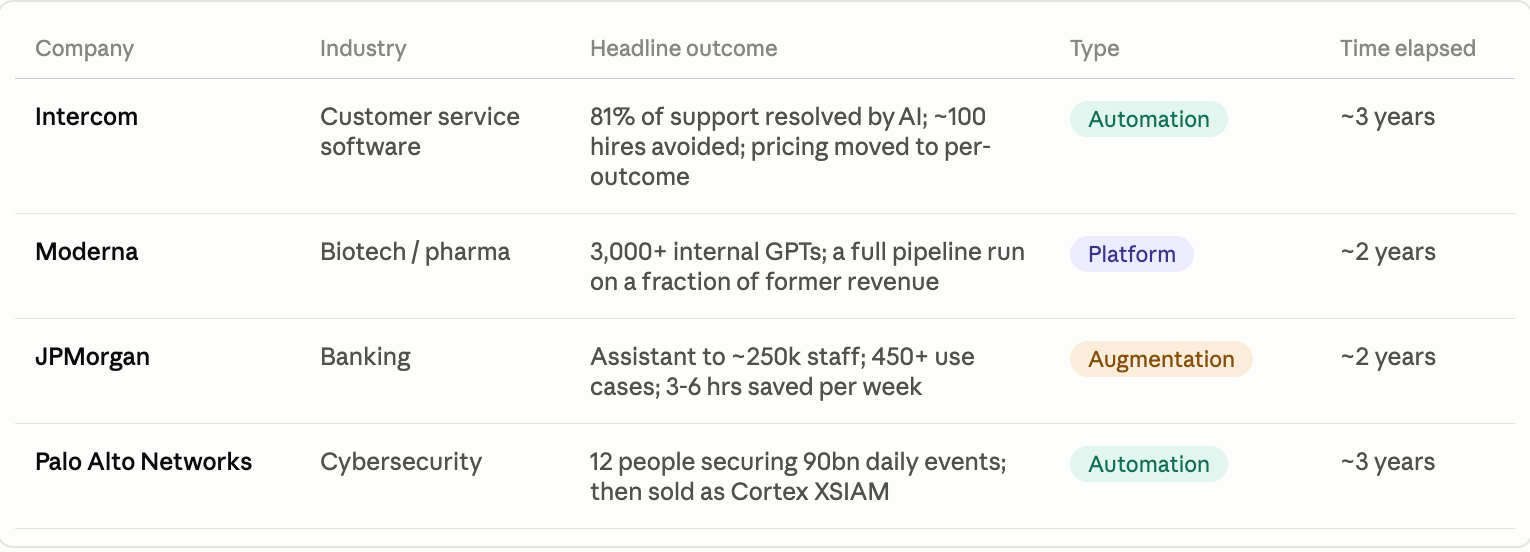
On the surface these four companies have almost nothing in common. A thousand-person software business, a shrinking biotech, a bank with 300,000 employees, and a cybersecurity vendor. Different industries, different regulatory environments, different starting positions - one acting from crisis, another from strength. If the mechanics still rhyme across that much variance, the pattern is real rather than a feature of any particular sector.
From my analysis, they do rhyme, in six specific ways.
It was a decision made at the top, with structural authority behind it. McCabe cancelled $60 million of revenue. Moderna restructured its executive team. JPMorgan put its Chief Data and Analytics Officer on the Operating Committee. Not one of these was an IT initiative that grew organically. Each required someone with the standing to compel change across business lines that would otherwise have politely declined - because in any large organisation, a function without authority can only offer tools, and offered tools get ignored.
The technology and people functions were deliberately fused. Moderna merged HR and digital under one executive. JPMorgan runs its workflow re-engineering as a joint effort between its CDAO and its head of HR. Intercom dissolved its support roles and rebuilt them as two new job families. Palo Alto’s analysts stopped triaging and started writing playbooks. In every case, someone recognised that AI enablement is a workforce redesign - and that if tooling reports into one function and roles, training and performance report into another, the two will never reconcile.
They built the scaffolding, not just bought the tools. Moderna’s AI Academy, prompt contest and champion network. JPMorgan’s training apparatus and use case factory. Intercom’s dedicated AI Support team. Ramp’s Dojo marketplace and Sensei guide. Every competitor these companies have could buy identical model access on identical terms. The scaffolding is what none of them could buy.
They went deep on one workflow before going wide. None of these started by handing everyone a chatbot. Intercom rebuilt support. Palo Alto rebuilt the SOC. Moderna proved mChat before the 3,000 GPTs followed. In each case a single workflow was redesigned end to end - data, roles, execution - before the approach was extended anywhere else. Depth first, breadth second. The companies that fail tend to invert this: they distribute tools broadly and change nothing deeply.
They measured outcomes, not activity. The metrics these companies report are business outcomes - Intercom’s resolution rate, Palo Alto’s mean time to remediate, Moderna’s cost base. Contrast that with the usual corporate AI update: seats activated, licences deployed, employees “engaging with” the tools. Usage measures whether people opened the software. Outcomes measure whether the business changed.
It took two to three years. Not a quarter, not a pilot cycle. Intercom’s arc runs from late 2022 to an 81% resolution rate today. Moderna took roughly two years to reach 3,000 GPTs. Anyone promising this transformation inside a financial year is either delusional, or lying to you.
Where they diverge, and why it matters
The most important difference between these four companies is what separates a measurable outcome from a claimed one.
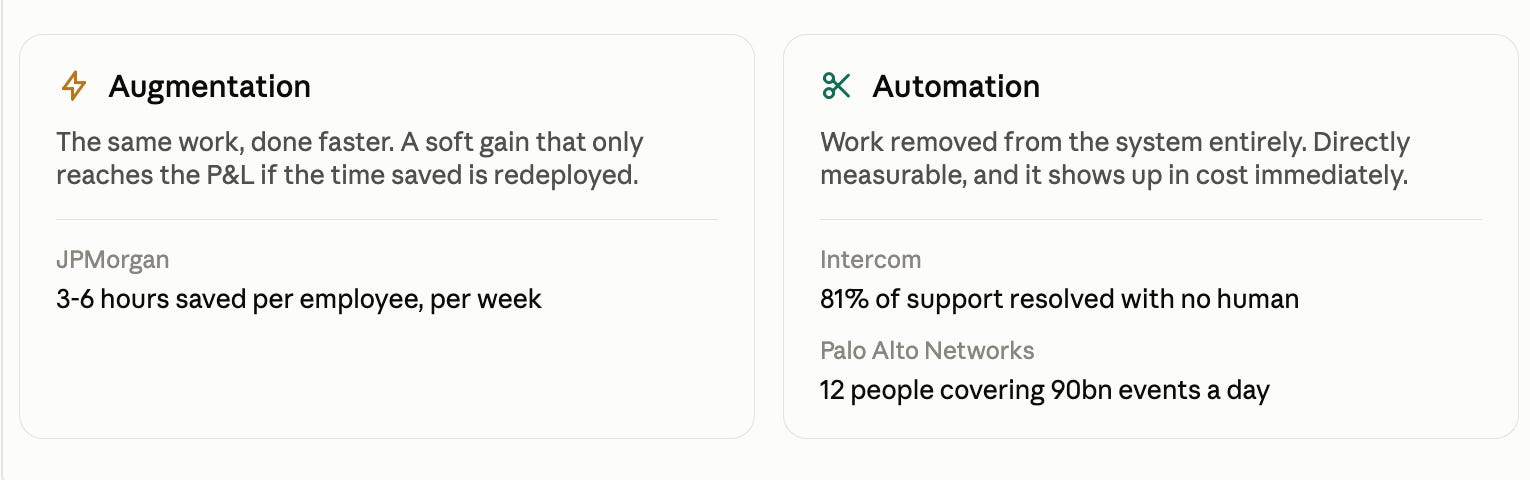
JPMorgan’s headline outcome is three to six hours saved per employee per week. Intercom’s is 81% of support conversations resolved without a human, and roughly 100 people never hired. Palo Alto’s is twelve people covering 90 billion daily events. The first is augmentation - the same work, performed faster. The second and third are automation - work removed from the system entirely.
Time saved is a soft number that only becomes value if it is redeployed into something that shows up in revenue or cost, and in most organisations it naturally dissipates into the working day. Work removed shows up immediately, because the headcount you didn’t hire and the tickets that never reached a human are directly measurable. It’s the difference between a productivity claim and P&L attribution.
Both are legitimate, and augmentation is often the sensible starting point - particularly in regulated settings, where autonomy has to be earned before it's granted. But when you're judging whether an AI programme has actually changed a business, the question to ask is which of the two it has produced: has work been taken out of the system, or is the same work simply happening faster?
The four questions I’d ask
Every management team now says they're using AI. The claim has become universal, which makes it useless as a credible claim. Assessing companies from the outside is what I do for a living, and I've settled on four questions that reliably separate the businesses that have genuinely become AI enabled from the ones using it as a vanity metric. The questions universally apply across most businesses.
Has anything been removed, or only accelerated? The augmentation-automation split above. If every metric is about speed, the production function hasn’t changed.
Have roles been formally redefined? Not “people are using AI in their work”, but: have job descriptions, competency frameworks and hiring criteria actually been rewritten? Intercom created two new job families. Moderna built an academy with defined progression. If the org chart and the role definitions look identical to three years ago, the tooling is sitting on top of an unchanged system.
Is there a counterfactual number? The most persuasive statistic in this entire article is Intercom’s estimate that meeting demand without Fin would have required at least 100 additional support staff. Companies doing this seriously know what they didn’t have to spend. Companies undertaking AI as vanity report usage statistics.
Has the cost or pricing model changed? The hardest test of the four. For a company that sells software, it shows up in pricing: Intercom charging per resolution rather than per seat is only possible because the software genuinely performs the labour (automation). For everyone else, it shows up on the cost side - revenue per employee, cost to serve, gross margin, the headcount curve against the revenue line. If AI has genuinely restructured how output gets produced, it has to appear somewhere in the unit economics. If the financial shape of the business looks identical to three years ago, the transformation is undoubtably questionable.
Who else is running this playbook
The four here are illustrative rather than exhaustive, and the list is lengthening. Shopify made reflexive AI use a baseline expectation and put it into performance reviews. Coinbase went further, setting a hard adoption deadline and parting company with engineers who ignored it. IBM has published specific savings from automating HR and back-office workflows at scale. Goldman Sachs has rolled its assistant firmwide, and Walmart has pushed AI deep into supply chain operations.
The more interesting activity, from where I sit, is happening in private companies that will never write a press release about it. Across the Fuel Ventures portfolio and at Abingdon, I’m seeing software businesses rebuild their delivery, support and sales functions around AI - some of them achieving the kind of output-per-employee numbers that would have been implausible three years ago. A handful are doing it exceptionally well, and the common thread is the same as everything above: they treated it as an operating model change rather than a tooling decision. It’s also why I’ve written before that this represents a generational opening for startups - a company with no legacy workflows to unpick can simply be designed this way from the beginning.
The investor read
The uncomfortable takeaway is that the technology was the easy part. Every company here ran on models their competitors could license on identical terms. What set them apart was the willingness to change the organisation from the top down - which happens to be the thing large incumbents are worst at.
Not through incompetence. Doing this properly means telling functional leaders their teams will shrink, rewriting the job descriptions of people you employ today, retraining a workforce that never signed up for it, and - in Intercom’s case - cannibalising your own pricing. Every one of those calls is unpopular, and most boards won’t make them until the competitive pressure is impossible to ignore.
That asymmetry is the investment thesis. Incumbents carry the cost base of an old operating model and enormous institutional resistance to changing it. AI-native challengers carry neither. When Intercom absorbs a 300% increase in demand without proportional hiring, or Palo Alto covers 90 billion daily events with twelve people, they aren’t just improving margins - they’re establishing a cost structure that competitors running the traditional model cannot match without going through the same painful transition.
So when I’m assessing a company now, incumbent or challenger, this has become a core part of the diligence. Not “do they use AI” - everyone says yes. But: what have they removed, what roles have they redefined, what didn’t they have to spend, and has the economic shape of the business actually changed.
Closing Thoughts
My honest view is that we are earlier in this than the discourse suggests, and that the eventual distance between companies that redesign around AI and companies that layer it on top will be wider than most people expect. In a few years nobody will describe themselves as AI-enabled, any more than they’d call themselves internet-enabled today. It will simply be how competent companies run.
None of this is comfortable. It’s a genuinely unsettling time to be running a company or building a career, and anyone claiming certainty about where it all lands is guessing. But I’ve rarely seen a period offering this much opportunity to people willing to properly apply themselves and lean-in. The tools are available to everyone, the playbooks are increasingly public, and the capability gap between the companies who lean in and those who show resistance has never been wider.
"Intercom moved to outcome-based pricing at $0.99 per resolution, and became arguably the first major SaaS company to make that shift." - my initial reaction was that this seems insanely expensive, but clearly the swing paid off. I imagine these prices will start dropping over time, too.